

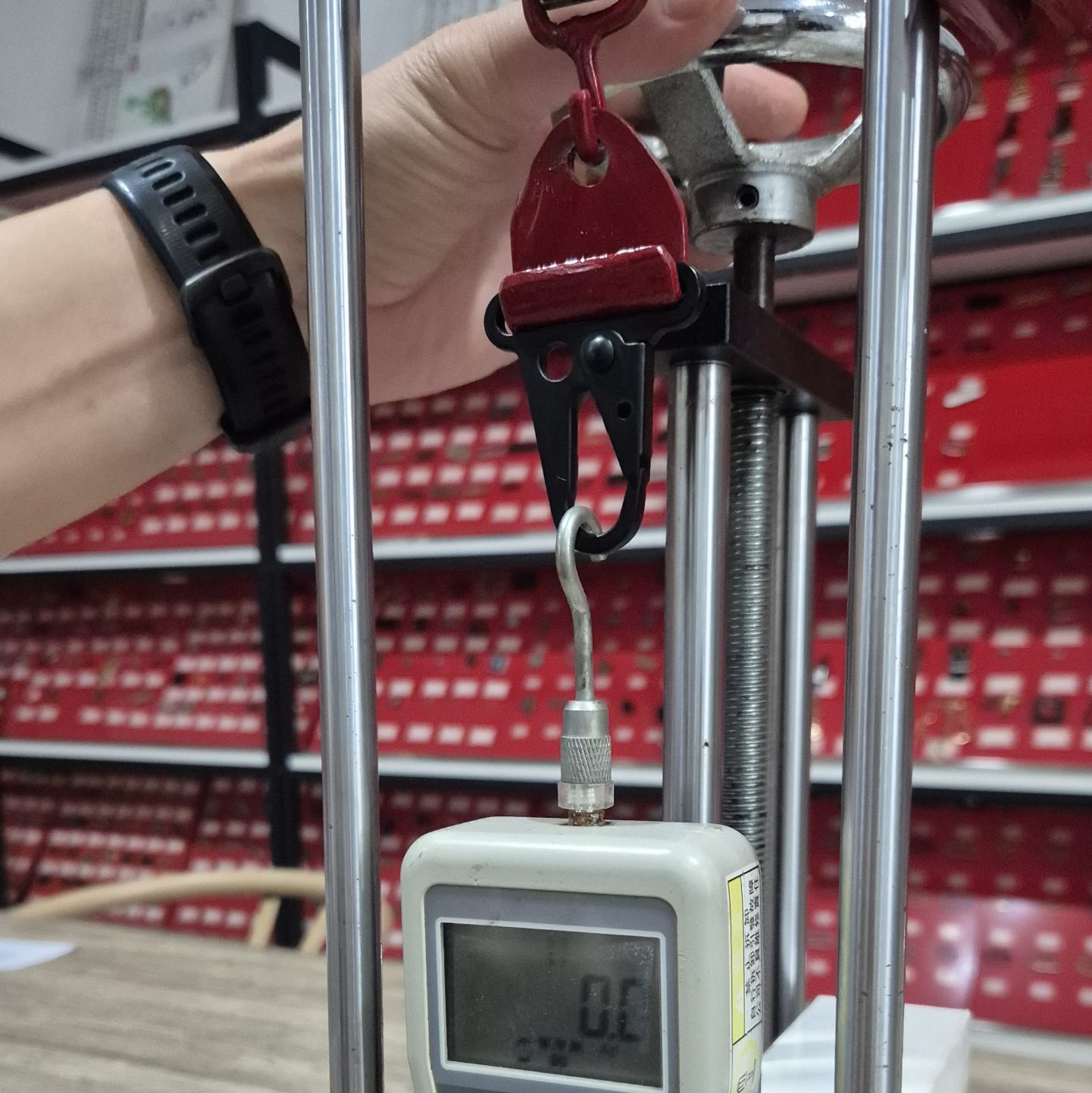
At Jin Global, we don’t just manufacture bag hardware — we test it. Here’s what happened when we put our clasp sling hook through a tensile strength test.
Why We Test
When a bag fails, it’s rarely the fabric. More often, it’s the hardware — a hook that opens under load, a ring that deforms, a clasp that gives way at the worst moment. For brands and manufacturers who specify our hardware, knowing exactly how much load a component can handle isn’t a nice-to-have. It’s essential.
That’s why we conduct in-house tensile strength testing on our hardware before it goes into production. This post walks through a recent test on one of our clasp sling hooks, how we tested it, and what the results showed.
The Product: Clasp Sling Hook
The clasp sling hook is one of the most mechanically demanding components in bag hardware. It needs to open and close reliably, hold a secure connection under dynamic load, and maintain its integrity across thousands of cycles of use. It’s commonly used on bag straps, shoulder slings, camera bags, and tactical gear — anywhere a quick-release connection needs to also be a strong one.
Our clasp sling hook is manufactured from zinc alloy using solid die-casting, with surface finishing options including electroplating and PVD coating, all compliant with REACH and RoHS standards.
The Test
We subjected multiple samples of the clasp sling hook to a tensile load test using our in-house testing equipment. Each sample was mounted axially and loaded at a consistent rate until failure or until the maximum test load was reached.
No minimum load requirement had been specified for this particular test run — our objective was to establish the actual failure threshold of the component under controlled conditions.
Result: all samples withstood a maximum load of approx. 60 kgf before reaching the failure point.
The failure mode was consistent across samples, allowing us to identify exactly where and how the component reaches its structural limit — information that’s directly useful for applications where load specifications need to be defined.
What 60 kgf Means in Practice
60 kgf is approximately 588 Newtons of force. To put that in context:
- A fully loaded travel backpack typically exerts 5–15 kgf on its attachment points under normal use
- Dynamic loads from movement and impact are generally estimated at 2–3x static load
- At 60 kgf failure threshold, this clasp sling hook carries a significant safety margin for everyday bag applications
For high-load applications such as tactical gear, safety equipment, or hardware subject to repeated dynamic stress, we recommend discussing load requirements with our team before specifying components.
Internal Testing vs. Third-Party Certification
The results presented here are from Jin Global’s internal quality control process. This test was conducted using calibrated in-house equipment and is intended as a reference for load performance under controlled conditions.
For applications requiring certified third-party testing such as products sold into regulated markets or subject to specific safety standards, we recommend commissioning testing through an accredited laboratory such as SGS, Bureau Veritas, or Intertek. We can facilitate this process on request.
Specifications
| Product | Clasp Sling Hook |
| Material | Zinc Alloy |
| Test Type | Static Tensile Load |
| Load Direction | Axial |
| Samples Tested | Multiple |
| Max Load at Failure | 60 kgf |
| Compliance | REACH & RoHS |
Interested in Load Testing for Your Hardware?
If you’re specifying hardware for a project with defined load requirements, we’re happy to share test data or conduct testing on specific components. Get in touch at jinglobal.contact@gmail.com or visit jinglobal.co.