

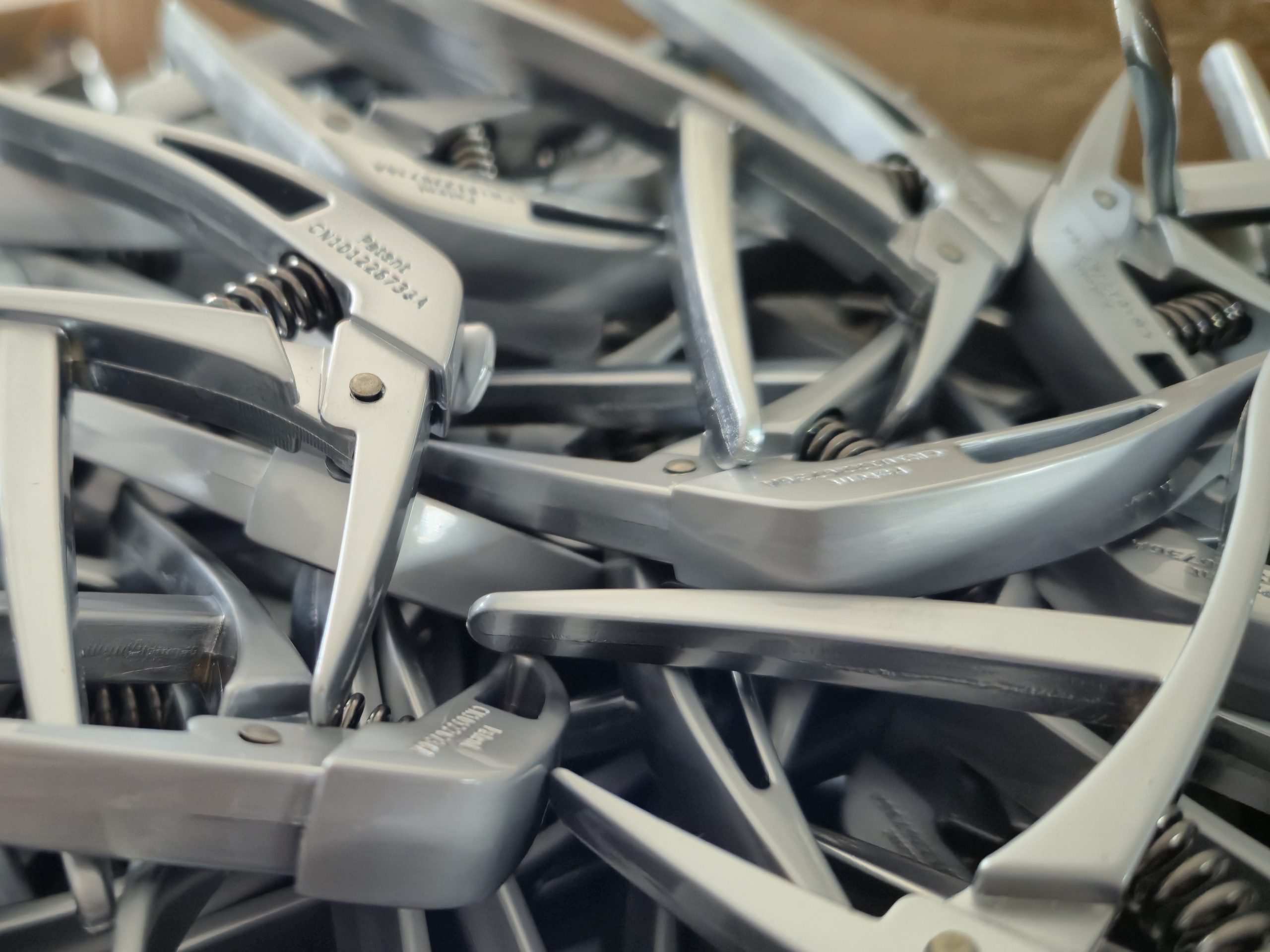
At first glance, a guitar capo looks like a relatively simple accessory. It clamps onto a guitar neck, presses down the strings, and allows musicians to change the pitch without changing their fingering positions.
But manufacturing a reliable metal guitar capo involves much more than producing a metal body.
Its performance depends on structural design, material selection, dimensional accuracy, mechanical components, and assembly consistency. Every part needs to work together to deliver stable clamping pressure without damaging the guitar or affecting sound quality.
We have been manufacturing metal guitar capos for nearly 20 years. Although this product belongs to the musical instrument accessories industry, it represents an interesting example of how metal product development, Zamak die casting, tooling, and assembly come together in a finished product.
Let’s take a closer look at the manufacturing details behind it.
Product Design: More Than Just a Metal Clamp
The primary function of a guitar capo is to apply sufficient pressure to the guitar strings so that they remain firmly pressed against the frets.
However, applying pressure is only part of the challenge.
The capo must distribute that pressure appropriately across the strings. If the pressure is insufficient or uneven, some strings may vibrate improperly, producing buzzing or inconsistent sound. Excessive pressure, on the other hand, may affect tuning accuracy or place unnecessary stress on the strings.

This means several design considerations need to work together:
- Clamping Force: The mechanism must generate sufficient and consistent pressure to hold the strings securely.
- Structural Rigidity: The metal body must resist deformation under repeated clamping forces.
- Contact Surface: The surfaces contacting the guitar neck and strings need suitable geometry and protective materials to avoid scratches or damage.
- Ergonomics: The capo should be easy to install, remove, and operate.
- Dimensional Compatibility: The design must accommodate the intended guitar neck profile and fretboard curvature.
Depending on the capo design, these requirements may be addressed through different mechanical structures, such as spring-loaded or adjustable clamping mechanisms.
The key is to balance functional performance, user comfort, and manufacturing feasibility from the beginning of product development.
Why Use Zamak Die Casting for a Metal Guitar Capo?

Material selection has a direct influence on product performance, manufacturing cost, appearance, and production efficiency.
Zamak, a family of zinc-based die-casting alloys, is widely used in the manufacturing of small and medium-sized metal components.
For products such as guitar capos, zinc alloy offers several manufacturing advantages.
Complex Shapes and Design Flexibility
Zamak die casting allows manufacturers to produce relatively complex geometries, including curved surfaces, mounting features, reinforcing ribs, and integrated structural details.
Compared with machining an entire component from solid metal, die casting can be an efficient way to manufacture complex shapes in volume.
Dimensional Consistency
With properly designed tooling and controlled production conditions, die casting can achieve repeatable component dimensions.
This is particularly important for products containing multiple assembled parts, where dimensional variation can affect fitting and mechanical performance.
Surface Finishing Options
Zinc alloy components can undergo various finishing processes, including polishing, electroplating, painting, and other decorative treatments.
This provides flexibility when developing products with different colors, textures, and appearance requirements.
Production Efficiency
Once the tooling has been developed and the process stabilized, die casting is suitable for repeatable mass production.
However, zinc alloy is not automatically the best material for every capo component. The selection should consider mechanical loads, wear requirements, component geometry, and the properties required from each individual part.
Tooling Development: Where Manufacturing Quality Begins
A good die-cast component starts with a well-designed mold.
Tooling development is one of the most important stages because mold design influences dimensional accuracy, surface quality, production stability, and manufacturing cost.
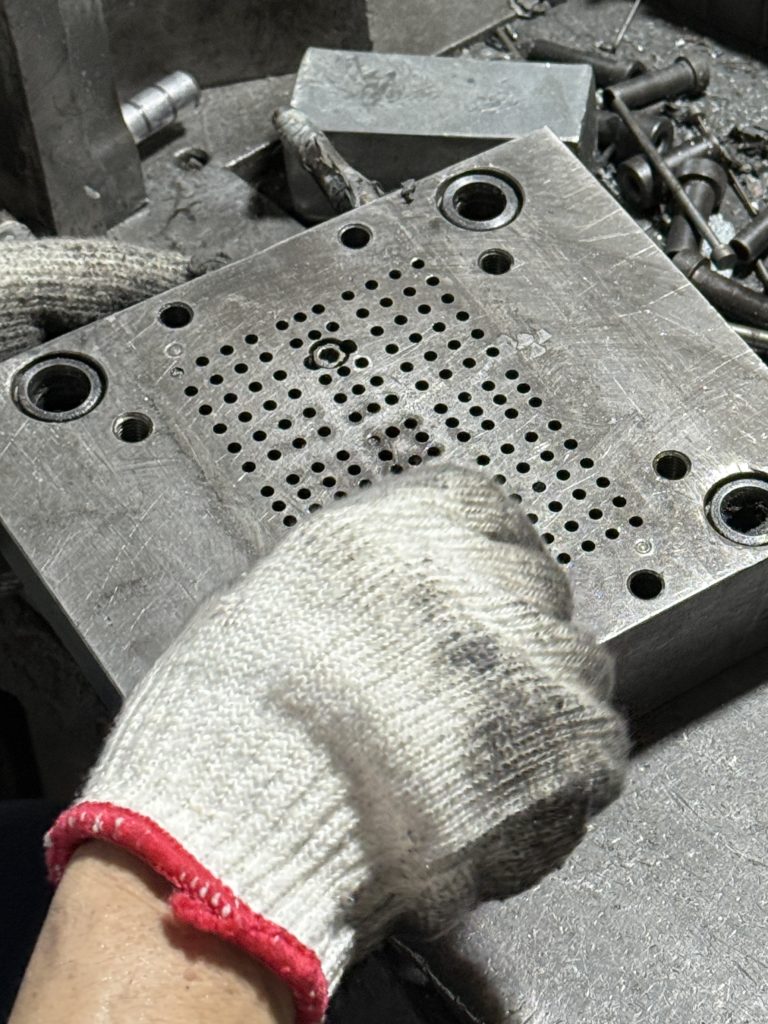
For a metal guitar capo, several factors deserve attention:
Wall Thickness and Structural Design
The component needs sufficient structural rigidity without unnecessary material usage.
Poor wall-thickness design may contribute to uneven filling, shrinkage defects, or inconsistent mechanical performance.
Gating and Venting
The molten zinc alloy must fill the mold cavity effectively. Gate location, filling behavior, and venting design influence the risk of air entrapment and casting defects.
Draft Angles and Part Ejection
Appropriate draft angles help components release from the mold without unnecessary surface damage or deformation.
Dimensional Control
Critical assembly features need particular attention. Small dimensional variations around mounting points, pivot areas, or connecting features may affect the fit and movement of assembled components.
The purpose of tooling development is not simply to make the first sample look right. It is to create a manufacturing foundation that can support consistent production over repeated batches.
Surface Finishing: Appearance and Functional Requirements
For a consumer product such as a guitar capo, appearance is an important part of its perceived quality.
However, surface finishing is not only about aesthetics.
Depending on the design, different components may require different surface treatments based on their material, function, and exposure during use.
For zinc alloy die-cast bodies, common finishing options include:
- Polishing: Improves surface smoothness and prepares the component for subsequent finishing.
- Electroplating: Creates metallic appearances such as chrome, nickel, or other decorative finishes.
- Painting or Coating: Provides alternative colors and surface effects.
Surface preparation is particularly important for die-cast components. Casting porosity, surface irregularities, and polishing defects may become more visible after decorative finishing.
A consistent finishing process therefore needs to begin with good casting quality and appropriate surface preparation.
Assembly: Small Tolerances, Big Functional Differences
A guitar capo is a finished mechanical product, not simply an individual die-cast component.
Depending on its design, the assembly may include a metal body, clamping mechanism, spring, pivot or connecting components, and protective contact pads.
Each component has its own function, but the final product depends on how accurately they work together.
For example:
- Incorrect fitting around a pivot may create excessive movement or unstable operation.
- Poor spring matching may result in inconsistent clamping force.
- Incorrect contact-pad positioning may lead to uneven pressure distribution.
- Dimensional inconsistencies may make assembly difficult or affect product functionality.
This is why assembly quality should not be treated as a separate step after manufacturing.
The design of individual components, tooling tolerances, component sourcing, and assembly methods should all be considered together.
Quality Control: Beyond Visual Inspection
A guitar capo may look perfect on the outside but still have functional problems.
For this type of product, quality inspection should cover both manufacturing appearance and actual performance.
Some important checks include:
Dimensional Inspection
Checking critical dimensions to ensure that components fit together correctly and meet drawing specifications.
Functional Testing
Checking whether the clamping mechanism operates smoothly and applies appropriate pressure.
Repeated Operation Testing
Operating the mechanism repeatedly to evaluate consistency and identify premature wear or functional problems.
Structural Inspection
Checking for casting defects, cracks, deformation, and other potential weaknesses in load-bearing areas.
Surface Quality Inspection
Inspecting for scratches, pits, plating defects, color inconsistencies, and other visible imperfections.
The specific test methods and acceptance criteria should be established according to the product design and customer requirements.
The objective is to ensure that the finished product performs consistently, not simply that it passes a visual inspection.
From a Product Concept to Long-Term Mass Production
Our experience manufacturing guitar capos for nearly 20 years has reinforced an important lesson: developing a product and manufacturing it consistently are two different challenges.
A successful manufacturing project requires coordination across multiple stages:
- Understanding the product’s intended function.
- Evaluating material and manufacturing feasibility.
- Developing suitable tooling.
- Establishing stable production processes.
- Coordinating component sourcing and assembly.
- Maintaining consistent quality across production batches.
Some customers come with complete technical drawings. Others start with an existing sample or an early-stage product idea.
In either situation, understanding the product’s functional requirements is the starting point for identifying the right manufacturing approach.
Looking for a Manufacturing Partner for Your Metal Product?
The guitar capo is just one example of the metal products we have worked on over the years.
At Metalism, we are interested in more than manufacturing individual metal components. We enjoy understanding how a product works, solving its manufacturing challenges, and developing practical solutions for repeatable production.
Our experience includes Zamak die casting, tooling development, metal finishing, component coordination, and product assembly.
If you have a product drawing, an existing sample, or an idea that involves custom metal components, we’d be happy to explore its manufacturing possibilities.
From an initial concept to a finished product, let’s turn your idea into something real.